The 8-Step Autopilot: How to Launch a 50-Person Campaign Before You Finish Your Morning Coffee
The minute-by-minute runbook one in-house marketer can use to brief, recruit, contract and schedule 50 micro-influencers before 10am. AUD pricing, AANA-compliant.
By Donkey Dan, edited by Dr Brent Coker

It’s 8:47am. You’ve just sat down with a coffee. By 9:35am you can have a 50-creator campaign briefed, launched, accepting applications, with payment in escrow and the AI doing the first pass on applicants. The brief is written. The contracts are signed. The marketing manager (you) is back to the rest of the day. This is the runbook for how that hour actually goes: what you do, what the platform does, and where the time stops disappearing into DMs and spreadsheets.
Why “campaign management tool” usually means spreadsheet purgatory
Search “influencer campaign management tool” and you’ll get listicles. Thirteen tools compared. Best for discovery, best for analytics, best for relationship management. Pick a stack. None of those guides tell you what an actual hour at your desk looks like. They sell you the stack and leave you to wire the workflow together yourself.
Most in-house marketers default to a spreadsheet because the spreadsheet at least matches the shape of the work: a row per creator, columns for status. The spreadsheet isn’t the problem. The problem is that across a typical campaign there are about fifteen touchpoints per creator: brief, contract, address, shipment, content draft, revisions, post verification, payment, reporting. Multiply by 50 creators and a fortnight cycle and you’re looking at 750 touchpoints. That’s the point where the wheels come off, and it’s a number we cover in more depth in the playbook for scaling micro-influencer campaigns.
An autopilot tool isn’t a better spreadsheet at all. It’s a different shape of work: a small number of human decisions wrapped around a much larger number of automated steps.
The autopilot mindset: three loops, eight steps
The eight steps below split into three operational loops:
- Recruit → Brief → Publish. Get a brief in front of qualified creators, get content back, get it live.
- Measure → Optimise → Pay. Verify posts, release escrow, log performance.
- Learn → Archive → Relaunch. Bank what worked, re-run with the next cohort.
Each loop has event-based triggers. A signed contract triggers shipment. Content approved triggers the 10-day payment countdown. A deadline passed without a post triggers the escrow refund. The marketing manager’s job is to set the policy on each trigger once, not to push the buttons fifty times.
That mental model is what makes the next hour possible. We’ve made the case for why this matters in our breakdown of the two things a bigger budget can’t fix, and the answer is workflow, not money.
0:00 — Step 1: Brief your campaign in 90 seconds
Open the campaign creator. The AI Brief Builder asks five strategic questions: what’s the goal, what’s the product, who’s the audience, which platform (TikTok, Instagram, or both), and what’s the deliverable shape (Reel, Story, TikTok, Carousel). You answer in a sentence each.
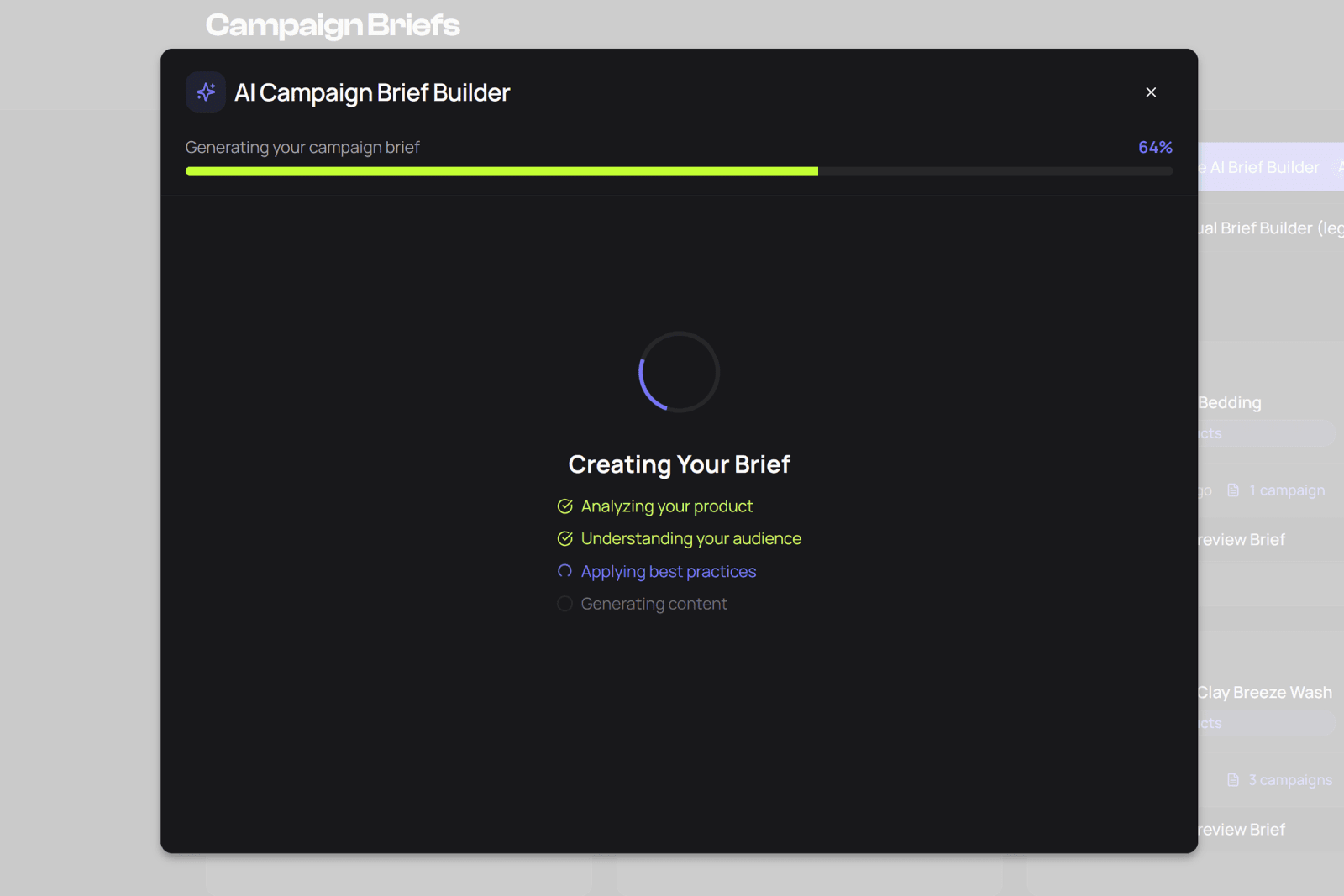
What comes back is a draft brief: content requirements, key messaging, hashtag suggestions, tone guidance, platform-specific specs. It’s not perfect. You refine it in the chat interface, tightening the tone, swapping a hashtag, sharpening the call-to-action. We’ve written a whole companion piece on the principles of writing briefs that don’t kill authenticity, but for now you’re picking from sensible defaults rather than starting on a blank page.
Set the fixed per-creator rate (AU$80 is a strong starting point for nano-creators; the Sprout Social 2025 AU benchmark puts micro-creator rates anywhere from AU$39 to AU$1,965 depending on niche and deliverable). Set the campaign cap, how many creators you want, at 50.
Time elapsed: 6 minutes.
0:08 — Step 2: Launch and watch the applications start arriving
Hit launch. The campaign goes live to the verified creator pool. The Attractiveness Gauge shows a 0–100 score before you publish. If it reads “Too Low,” the platform tells you exactly why (rate, requirements, market timing) and what to change.

There’s no cold outreach. There’s no DM-blasting fifty creators in your niche. The campaign is browsable to anyone who matches the audience filters, and applications come inbound. This is the single biggest time saving in the whole workflow. Outreach normally consumes days, and it produces a lower hit rate than inbound applications from creators who self-selected because they actually liked the product.
While you’re still finishing your coffee, the first applications are arriving.
Time elapsed: 10 minutes.
0:25 — Step 3: Select your 50 (and let the system filter the rest)
Open the applications view. Each applicant arrives with a Trust Score (0–100), a verification badge if they’ve been through ID checks, performance tier (Starter, Rising, Established, Premium), Safety Check status, and audience demographics. The 17+ badge system flags first responders, top-rated creators, niche experts.

You’re not vetting from scratch. The platform’s already filtered for bot followers, fake engagement, and brand-safety risk before any applicant reached you. Your job here is taste. Does this creator’s content match the brief, do their followers match the target audience, would you be happy seeing your brand in their feed.
For a 50-creator cohort, this is the step where you spend the most clock time. Expect 15–20 minutes if you’ve been selective. Most marketers we work with bulk-accept 40 obvious yeses, individually consider 20 maybes, and reject the rest. Set up filters once for niche and follower range, and the unqualified applicants never reach your inbox in the first place. This is part of why we lean so hard on the micro-creator angle over celebrity deals.
Time elapsed: 40 minutes.
0:40 — Step 4: Pay once into escrow, done
The moment you accept a creator, payment is charged to your card or bank and held in escrow. Not paid out. Held. The creator sees confirmation that funds are committed. You’ve made the contractual handshake, but your money is safe until the work is done.
This is the second-largest reduction in workflow drag. There’s no AP cycle. No invoicing. No purchase orders. Fifty creators at AU$80 is AU$4,000 charged in one transaction, sitting in escrow against fifty individual contracts. The platform handles the accounting. The same transaction would normally generate fifty separate invoices and consume your finance team for a fortnight.
Time elapsed: 42 minutes. You drink the rest of your coffee. The active part of your morning is over.
0:42 onward — Step 5: Creators get briefed, you get on with the day
Briefs go out automatically to all 50 accepted creators with their personalised contract. The platform’s AI Content Suggestions pre-fill caption and hashtag drafts for each creator based on your brief. They can insert with one click or start fresh, which helps them deliver content aligned with your brand voice without losing their own.
The creators see the brief, the rate, the deliverable spec, the deadline, and the brand voice guide. They submit drafts back into the platform when ready, typically within 5 to 10 days. You don’t manage that window. You’re working on something else.
This is where the autopilot model earns its name. There’s no progress chasing because there’s no need to chase. Every status change is reflected on one dashboard, and the creator sees the same dashboard you do. If a creator hasn’t submitted by the halfway point of the deadline, the platform nudges them automatically.
Day 7 — Step 6: One revision, then signed off
Around day 7, drafts start arriving. The Content Review Hub is where you spend your second meaningful chunk of attention.

You approve or request one revision. The platform enforces this as a hard limit. Not because we’re stingy with feedback, but because two-round revision loops train creators to under-invest in their first submission. One round is the maximum if the brief was clear. The policy can’t quietly drift because the software doesn’t let it.
A typical pattern for a 50-creator cohort: 35 approved on first pass, 12 sent back for one revision, 3 rejected (out of brief). The 35 first-pass approvals trigger the next loop automatically.
Time elapsed in this session: ~15 minutes for the review pass.
Step 7: Publish happens in the background
Approved content gets a green light to publish. Creators post to their TikTok or Instagram within their committed window, usually 24 to 72 hours after approval. The platform monitors for the live post via URL submission and content verification.
There’s no “publish step” you do. You set the schedule policy once at campaign creation, and the platform handles the live-post detection automatically. You’ll see posts going live on the dashboard as they happen. We track every post URL automatically, which is what feeds multi-touch attribution back to your actual campaign performance. No manual link collection across DMs and email.
Day 14 — Step 8: Auto-release, and the campaign closes itself
Once a post is verified live, a 10-day countdown starts on that creator’s escrow payment. If the brand has no flags by day 10 (and almost no brand does, because the content has already been approved) the payment auto-releases.
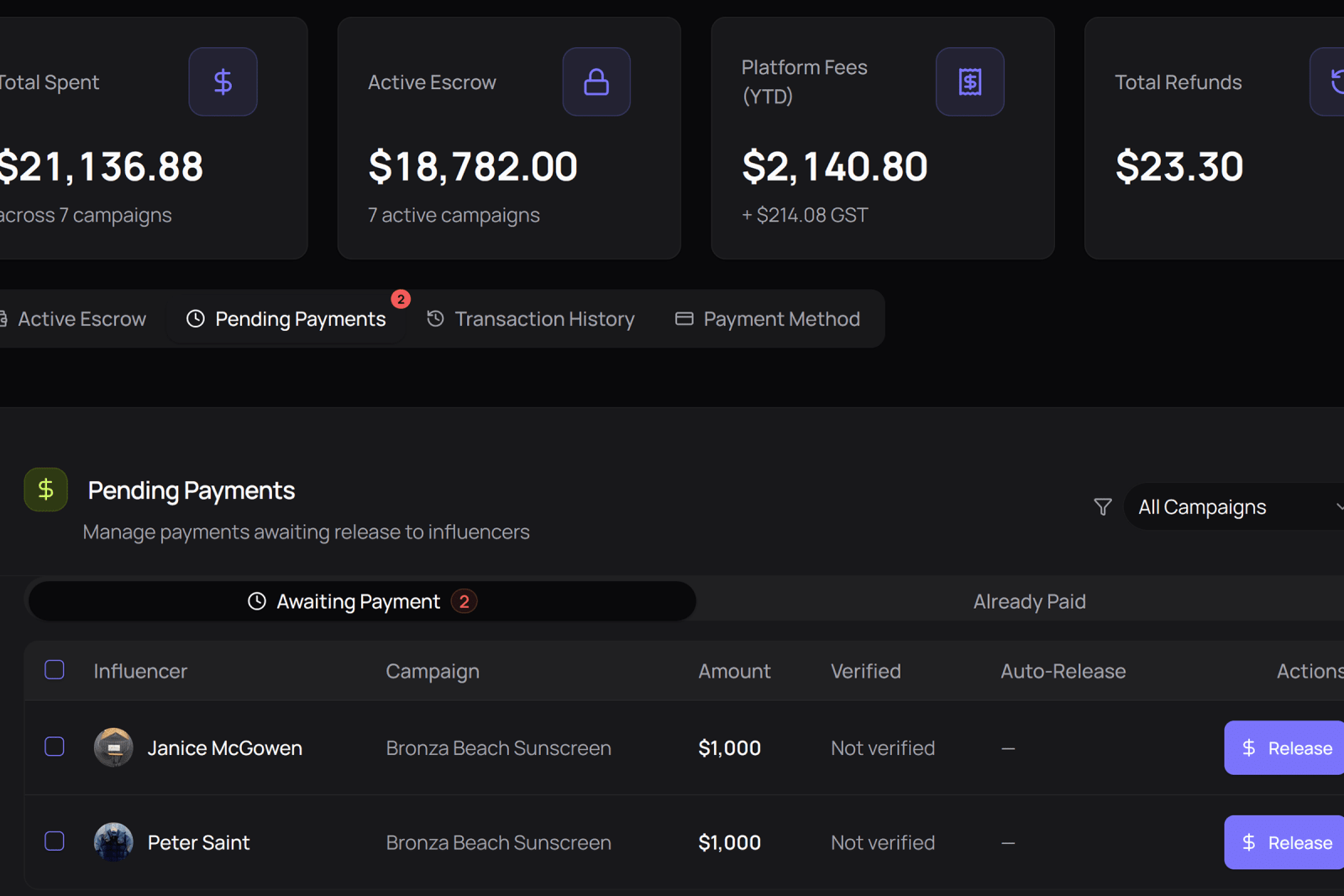
You don’t release payments. The platform does. The same pattern fires fifty times across the next fortnight. By day 24, about three weeks after that 8:47am coffee, the campaign has closed itself: every post live, every creator paid, performance analytics aggregated and ready for the next-cohort decision.
That’s the whole loop. Roughly 65 minutes of marketing-manager desk time across the entire campaign: 42 minutes for launch, 15 for review, 8 in scattered glances at the dashboard.
Where the 15–20 creator wall used to live
The reason this matters isn’t the speed. It’s where the ceiling moves. Across the brands we onboard, the operational cliff for in-house programmes sits between 15 and 20 concurrent creators. Below it, a competent marketing manager with Notion and a shared spreadsheet can muddle through. Above it, the load goes non-linear: fifteen touchpoints per creator times twenty creators is three hundred touchpoints across a fortnight, and somewhere in there the messages start slipping.
The compound failure mode is communication first, compliance second, reporting third:
- Response-to-creator time drifts from same-day to 48 hours.
- First-submission approval rates drop as briefs lose personalised attention.
- AANA disclosure tracking becomes ad-hoc, which is how brands end up like Photobook Shop, fined AU$39,600 by the ACCC in March 2026 for undisclosed gifted reviews valued between AU$50 and AU$400 each.
- Performance reporting lags the campaign by weeks, removing any chance of in-flight optimisation.
Every feature in the eight-step workflow exists to push that ceiling out. It’s the same design choice behind the whole playbook for scaling micro-influencer campaigns end-to-end. Bulk operations replace per-creator manual handling. Escrow auto-release replaces invoice chasing. The one-revision rule replaces five-round spirals. AI Brief Builder replaces the three hours of brief-writing you’d otherwise do for the cohort. The cumulative effect is that 50 creators feel like 5, and 100 creators are still a normal week’s work rather than a crisis. That’s the operational answer to the question we cover at the strategy level in the case for choosing an influencer platform over a stack of point tools.
What you’ve got before your coffee goes cold
By 9:35am, the answer is concrete:
- Brief written: by the AI in your voice, refined by you in 5 minutes.
- Campaign live: applications inbound from the verified creator pool.
- 50 creators selected: Trust Score and Safety Check filtered, vetted in 15 minutes.
- AU$4,000 in escrow: one transaction, fifty contracts.
- Briefs distributed: every creator has the brief, the rate, the deadline, the brand voice.
- Tracking wired: every post URL, every metric, every escrow release on automatic.
There are categories of work where the right tool moves the ceiling by 20%. Influencer campaign management is one of the few where the right tool moves the ceiling by an order of magnitude. Not because campaign software is magic, but because the alternative is asking one person to track 750 things in their head for a fortnight.
Coffee’s not even cold.
Frequently asked questions
Can I really launch an influencer campaign in under an hour?
Yes, if software handles the eight coordination steps instead of people. The blocker was never the writing. It’s the 750 touchpoints a 50-creator cohort generates across a fortnight. Software collapses that into a single dashboard with event-based triggers. The marketing manager’s actual desk time drops to about 50 minutes for the launch, then a 15-minute review session a week later.
How does the AI Brief Builder write a brief in 90 seconds?
You answer five strategic questions about the campaign (goal, product, audience, platform, deliverable) and the AI generates content requirements, key messaging, hashtag suggestions, and tone guidance. You refine with a chat interface until it’s right. It doesn’t replace your thinking. It removes the typing.
What stops creators from ghosting once they’ve been paid?
Payment isn’t released on hire. It’s released after the post goes live and gets verified, on a 10-day auto-countdown. The brand’s money sits in escrow until then. If the creator never posts, the money returns to the brand. That single mechanism caps the downside risk on any one deal at zero, which removes the structural reason most micro-influencer campaigns over-rotate on individual creator quality.
Why only one revision?
Two-round revision loops train creators to under-invest in their first submission. One round is the maximum if the brief is clear. Anything more and you’ve lost the speed advantage that micro-influencer marketing exists to deliver. The platform enforces it as a hard limit so the policy can’t quietly drift.
Do I need to verify creators myself?
No. Every creator on the platform has been through AI verification (follower authenticity, engagement ratios, post history) plus admin review. You get a 0–100 Trust Score per creator before you accept them. Safety Check AI also runs a separate brand-safety scan across scandals and controversies, silent to the creator. Your job is taste, not detective work.
What does a 50-creator campaign actually cost in AUD?
It depends on niche, but the Sprout Social/Statista 2025 Australian benchmark puts micro-influencer rates (10k–100k followers) between AU$39 and AU$1,965 per post. For nano-creators (1k–10k) on fixed-rate campaigns, AU$50–AU$200 per post is a common band. A 50-creator cohort at AU$100/post comes to AU$5,000 in creator spend. That’s a fraction of one macro deal at AU$15,000–AU$50,000 for a single post.
Ready to run the runbook on your next campaign? See how the platform works and pick a tier that fits your cohort size.
Ready to get started?
Launch your first campaign or join as a creator today.